Search for
All you need
What do you need to look?
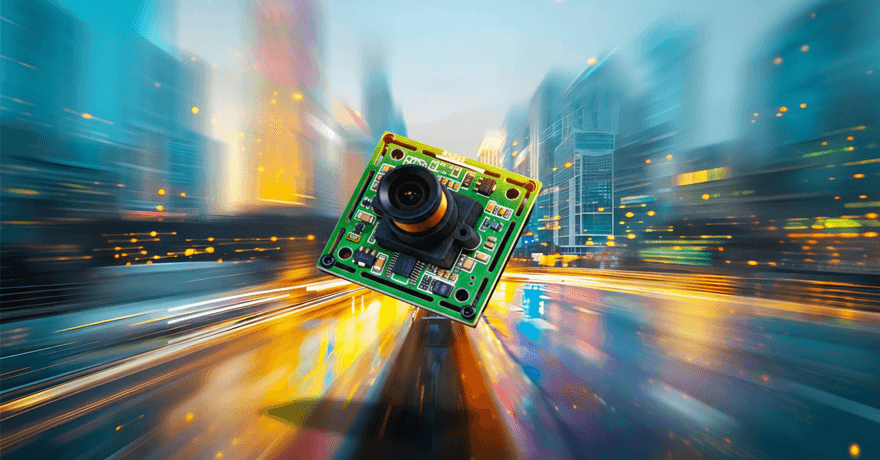
When a self-driving car is speeding at a speed of 120 kilometers per hour, its "eyes"-the camera system-must send high-definition images to the "brain" (ECU) within a few milliseconds for analysis and decision-making. This is not just data transmission, it is a relay race related to safety under the test of extremely noisy electromagnetic environment, continuous vibration and temperature difference of minus 40 degrees to 105 degrees above zero. The traditional MIPI CSI-2 interface for consumer electronics is stretched in large automotive architectures. At this time,SerDes (Serializer/Deserializer) TechnologyFrom behind the scenes to the front, it has become a key bridge connecting distributed cameras and central processing units.
Simply put, SerDes is a point-to-point communication architecture designed for long-distance, highly noise-resistant video transmission. Its workflow is like an efficient messenger system:
Serialization (on the camera side): The serializer chip in the camera module "packs" 8-16 parallel data generated by the image sensor and compresses it into a high-speed serial bit stream.
Transmission (via cable): This high-speed data stream passes through the body through a single shielded cable (coaxial or twisted pair), with a typical transmission distance of up15 m, Enough to extend from the front windshield to the trunk controller.
Desializer (at ECU side): The deserializer chip located in the electronic control unit "unpacks" the received serial data and restores it to a parallel format that can be recognized by the processor.
The core advantage of this process isto simplify. It uses a high-quality shielded cable to replace the dozens of thin wires required for traditional parallel interfaces, which not only greatly reduces the weight and wiring complexity of the wiring harness, but also because of itsdifferential signal transmissionandFull ShieldingIt has a strong immunity against electromagnetic interference sources such as the ignition system, motor, and high-power audio in the car.
SerDES signals eventually land through physical connectors. Car gauge connectors should not only be "connected", but also "connected stably and for a long time". The following is an in-depth comparison of the four mainstream schemes:
| Characteristics | FAKRA | Mini-FAKRA | HSD | high speed twisted pair |
|---|---|---|---|---|
| Architecture | 50Ω coaxial | 50Ω coaxial | 100Ω differential | 100Ω differential |
| Bandwidth | Up to 6 GHz | Up to 20 GHz | Optimized for LVDS etc | Multi-Gbps Capability |
| Dimensions | Standard | 80% smaller than FAKRA | Compact | Compact |
| Key advantages | Excellent cost, ecological maturity | High bandwidth, space saving | Strong anti-crosstalk ability, flexible wiring | Extreme EMI resistance |
| Typical applications | HD to 4K ADAS camera | 4K/8K multi-camera system | LVDS camera, in-vehicle infotainment | High electromagnetic interference environment |
Type selection through train:
The pursuit of reliable and cost-effective: For surround view and front view cameras from 1080p to 4K,FAKRAIt is still the gold standard that has withstood the verification of tens of millions of vehicles.
Facing the dual challenges of space and bandwidth: When your design needs to accommodate more 4K or even 8K cameras, and the PCB space is every inch of gold,Mini-FAKRAThe inevitable direction.
Using differential architecture such as LVDS: If the camera module itself outputs LVDS signals, or the system is particularly sensitive to cross-talk, you should choose aHSDConnectors.
Dealing with extreme electromagnetic environments: In some special vehicles or industrial automatic guided vehicles (AGV), if the camera cable must pass near strong interference sources such as motors and electric drives,high speed twisted pairThe interface provides the highest level of signal integrity assurance due to its natural common mode noise rejection capability.
A vital reminder: Impedance matching is the bottom line! Must be matched for FAKRA/Mini-FAKRA50Ω coaxial cablefor HSD/High Speed Twisted Pair100Ω Shielded Twisted Pair, Any mismatch will cause signal reflection and greatly reduce the link quality.
Let's take a typical 360-degree surround view system and connect the entire SerDes link in series:
A wide-angle camera is installed under the front, rear, left and right rearview mirrors of the vehicle. The images captured by each camera are converted to high-speed streaming by the built-in serializer chip.FAKRA ConnectorandCoaxial cableSend out.
These cables, like the optic nerve, converge to a central computing platform located in the middle and rear of the vehicle. The connector ensures lossless signal access here, and the deserializer chip restores the data and feeds it to the powerful AI processor through the MIPI CSI-2 interface for screen stitching, object recognition and trajectory prediction.
Low latency is the lifeblood of it all. At a speed of 80 kilometers per hour, the vehicle moves about 2.2 centimeters per millisecond. The SerDes link itself adds only a microsecond delay, which means that the vehicle's "thinking distance" from seeing an obstacle to the system making a decision is reduced to the shortest possible time, winning valuable reaction time for emergency braking (AEB) or steering avoidance.
Designing a theoretically perfect SerDes vision system is only the first step. How do you ensure that selected high-performance connectors (such as Mini-FAKRA) are available in a stable and timely manner? How do you get the right impedance matching and PCB layout recommendations at the design stage? Who can respond quickly when the production line needs support?
This is exactlyBONCHIP as an authorized distributor of several top connector manufacturersThe value lies. We know that the success of the automotive project lies not only in the design on the drawings, but also in the seamless connection from sample to mass production.
Full line of products and reliable supplyWe offer everything from standard FAKRA to cutting-edge Mini-FAKRA, HSD and moreFull line of automotive connector and cable solutions. Our inventory management and supply chain system is designed to provide youOptimum delivery stabilityto ensure that your project cycle is not disrupted by material shortages.
deep technology collaborationOur tech team goes beyond just sales. We can help you interpret the reference designs provided by the chip manufacturer, share our expertise in key areas such as connector selection, PCB footprint design on the board side, and cable specification verification, and assist you in avoiding common signal integrity and EMC pitfalls.
One-stop support from sample to mass production: Whether it is the sample demand at the initial stage of research and development, or the batch order during mass production climbing,BONCHIPCommitted to providingThe most convenient and efficient serviceto become your trusted supply chain partner, allowing you to focus more on core algorithms and system integration.
The current market isAnalog Devices的GMSLandTexas Instruments的FPD-LinkSuch as private agreements dominate. However, promoted by the MIPI AllianceA-PHYOpen standards are emerging to break down single-supplier dependency and provide automakers with greater flexibility and long-term supply chain security. In the future, with the integration of 8K cameras, high-precision radar and lidar, the demand for data transmission bandwidth will increase exponentially, and SerDES technology and matching connectors (such as higher-frequency Mini-FAKRA) will continue to evolve to carry a larger torrent of perceived data.
Conclusion
The automotive SerDes camera system is the invisible artery that connects physical vision with digital intelligence. It is unknown, but vital. Each component of this artery-from protocols and cables to connectors-needs to be selected based on a deep understanding of the application scenario, performance boundaries, and cost structure. And with likeBONCHIPSuch cooperation with partners with product knowledge, technical support and supply chain strength will undoubtedly add a solid guarantee to the reliability and smooth flow of this "lifeline.