Search for
All you need
What do you need to look?
Wakefield Thermal 10 × 36 inch aluminum extruded radiator 125593, 10 inches (254mm) wide, 36 inches (914.4mm) long, 2.53 inches (64.3mm) high, θSA 0.609 C/W(3 inches natural convection), aluminum extruded profile, without surface treatment, can be cut short, drilled, tapped and anodized according to the drawing. BONCHIP authorized distributor, genuine original products, supports sample and bulk quotations.
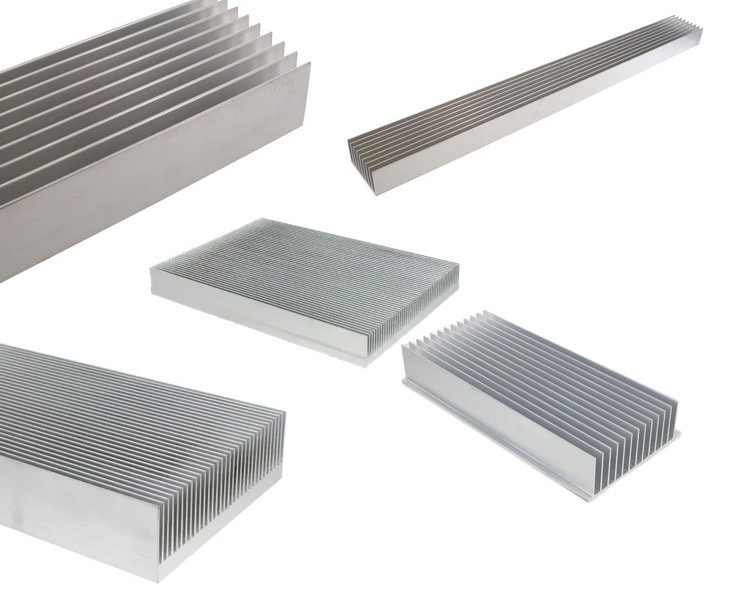
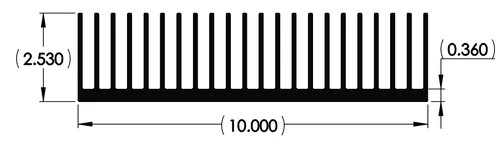
125593 belongs to the Wakefield Thermal extruded profile (Extrusion) product line. The cross section is straight fins, and the bottom plate is flat and has no mounting feet. Width 10 inches (254mm), length 36 inches (914.4mm), total height 2.53 inches (64.3mm), corresponding to original profile number 13953, drawing code SF1002, factory aluminum natural color, no surface treatment.
This is a cross section of "wide bottom and high teeth": 10 inches in width provides a large fitting area, 2.53 inches in total height allows sufficient convection space between teeth, natural convection is available, and the thermal resistance can be significantly reduced after strengthening the air cooling. 36 inches is the length of the whole branch cut section, and most of the actual projects are cut short according to the drawing. The typical scene of the whole branch on the machine is a long strip power supply, cabinet floor and experimental platform.
The thermal resistance given by the original factory is θSA 0.609°C/W, provided that the length is 3 inches, natural convection. This value is used to compare the performance of the same section at different lengths, not the absolute thermal resistance of the entire 36 inches. See "Thermal Performance and Selection" below for conversion methods and applicable boundaries ".
· 10 inch wide section.The single branch has a large coverage area, which is suitable for the unified heat dissipation of the whole power board, multi-tube parallel module or the whole row of devices.
· 2.53 inches (64.3mm) total height.The convection space between teeth is sufficient and natural convection is available. After adding a fan along the cogging direction, the thermal resistance can be reduced by another gear.
· Theta SA 0.609°C/W/ 3 inches.According to the length, the 36-inch unit is about 0.051°C/W, which is a common interval for high-power power supplies and power modules.
· The section perimeter parameter 114.778 in².The heat dissipation perimeter in the same width interval is large, and the heat dissipation area under natural convection is sufficient.
· Flat back bottom plate.The whole surface is attached to the heating surface, and the thermal pad, thermal conductive silicone grease or pressure plate is suitable for crimping. The contact area is large and the interface thermal resistance is easy to be pressed down.
· 36 inch whole branch cutting section.The cutting section along the extrusion direction is unchanged; The long strip equipment can be directly used as a whole or cut short according to the drawing.
· No surface treatment.Do not pay for processes that are not used; when anti-corrosion, corrosion-resistant appearance or black is required, separate anodizing is performed.
· Support secondary processing.Cutting, drilling, tapping, milling, chamfering, anodizing, can be completed in the original factory or in China according to the drawing.
· Drawings are available upon request.According to the original profile number 13953 and drawing code SF1002, the profile and 2D/3D drawing files are obtained to facilitate structural modeling.
· Authorized channels.BONCHIP for the Wakefield Thermal authorized agents, original genuine, batch and source can be traced back.
Table
| Parameter item | Specifications |
|---|---|
| Brand | Wakefield Thermal |
| Part number | 125593 |
| SKU | 125593 |
| Original profile No. | 13953 |
| Drawing/Code | SF1002 |
| Product Category | Aluminum Extruded Radiator (Extrusion) |
| Width | 10 inches/254mm |
| Length | 36 inches/914.4mm |
| Height | 2.53 inches/64.3mm (with baseplate) |
| Thickness of base plate | The original factory page is not listed separately, subject to the profile. |
| Tooth height | The original factory page is not listed separately, subject to the profile. |
| Section form | Straight tooth fin, flat base plate, no mounting feet |
| Section perimeter parameter | 114.778 in² (original caliber, used to estimate convective heat transfer area) |
| Material | Aluminum extrusion, common 6063-T5 |
| Surface treatment | Not treated (Unfinished) |
| Thermal resistance | θSA 0.609°C/W/ 3 inches, natural convection |
| Installation method | Thermal interface material is bonded and clamped by a pressure plate or clamp; or it is fixed by secondary machining to create mounting holes. |
| Processable Items | Cutting, drilling, tapping, milling, anodizing, sandblasting |
| Place of origin | The original manufacturer’s shipping label shall prevail; a certificate of origin (COO) can be provided. |
| Authorized Agent | Bangjing Technology (BONCHIP) |
| Supply and Delivery Schedule | In-stock models can be shipped quickly; for non‑stock items, please refer to the manufacturer’s lead time and confirm via inquiry. |
| Sample | Sample requests are supported, subject to stock availability. |
The premise for θSA of 0.609°C/W is 3 inch length, natural convection. If the same section is lengthened, the thermal resistance will decrease approximately according to the reciprocal of the length. According to this linear conversion, 12 inches is about 0.152°C/W, and 36 inches is about 0.051°C/W. These figures can only be used as a reference of magnitude, as it assumes that the heat source spreads evenly along the entire length of the segment and the entire segment participates in heat dissipation.
Table
| Segment length | θSA estimation (°C/W) | Estimate of heat dissipatable (W) | Applicable Judgment |
|---|---|---|---|
| 3 inches | 0.609 (factory value) | Approximately 66 | Benchmark working condition, short section proofing |
| 6 inches | Approximately 0.305. | Approximately 131. | Single power module |
| 12 inches | Approximately 0.152. | Approximately 263. | Medium Chassis Backplane |
| 24 inches | Approximately 0.076. | Approximately 526. | Long power supply, dense devices |
| 36 inches | Approximately 0.051. | Approximately 788. | For the whole base plate, the heat source shall be evenly distributed. |
· It can be used when the heat source is dispersed.Multiple devices are arranged along the length, and the deviation of the converted value is usually within 20%, which can be directly used for primary selection.
· Not available when the heat source is concentrated.A single IGBT or power module is attached to one end, and the diffusion thermal resistance is dominant. The measured value will be significantly higher than the converted value. It needs to be re-evaluated according to the size and location of the heat source.
· 36 inches is the upper limit, not the norm.Under natural convection, the boundary layer thickens with length and the tooth efficiency decreases, and the real improvement is much smaller than the linear conversion; the length of the whole branch is recommended to be measured or simulated, and if necessary, it is changed to forced air cooling.
· Forced air cooling to change the benchmark.After the wind speed comes up, the thermal resistance decreases, and the 0.609 of natural convection is no longer applicable. It is necessary to re-take the curve according to the air volume and the cogging direction.
· The interface layer is calculated first.0.5mm thick, 2W/(m · K) thermal pad, thermal resistance per unit area is about 2.5 cmK/W; When the bonding area is only 1cm, this layer is 2.5 C/W, which is greater than the converted value of the body. For small heat source scenarios, the interface layer is counted first.
· Interface Materials.A thin layer of thermal conductive silicone grease (spread by pressure) or thermal pad (thickness selected according to the gap) is added between the heating surface and the bottom plate, and it is recommended to control it at 0.05-0.125mm.
· Fixed way.There is no mounting foot. The common practice is to press the radiator to the heating surface with a pressure plate, clamp or chassis side plate; when screw fixing is required, drill holes and tap teeth on the bottom plate, and avoid the tooth root.
· Compression force.The span is 36 inches long. It is recommended to press at multiple points along the length to avoid the formation of air gaps in the middle; clean and degrease before pressing.
· Air duct design.Equipped with 120-172mm axial flow fan blowing along the cogging direction, leaving no less than the tooth height space at the air inlet and outlet; horizontal blowing will obviously lose performance.
· Secondary processing.Cutting, drilling, milling, chamfering and anodizing can be processed according to the drawings. The price and delivery date vary with the process. The drawings shall be given before placing an order.
· Surface treatment.Anodizing is recommended for outdoor or high humidity environments; black oxidation is slightly helpful for radiation heat transfer under natural convection, and the main value is still anti-corrosion.
Switching power supplies, rectifiers, UPS and power converters
・Power stage heat dissipation for frequency converters, inverters, and servo drives
・ Base plate heat dissipation of IGBT, thyristor and diode modules
Communication base station, radio frequency power amplifier, optical transmission equipment
・Charging pile power module, energy storage PCS, photovoltaic inverter
Industrial control cabinets, PLC and automation equipment power supply
Electric welding machine, cutting machine and other high current equipment
Long strip cabinet bottom plate and experimental platform load heat dissipation
Testing and measuring instruments, laboratory DC power supply
・Ruggedized computers and ruggedized cabinets
Is 0.609°C/W the thermal resistance of the whole 36 inches?
A:It is not an absolute value, it is the original nominal value under 3 inches length and natural convection. 36 inches is converted to about 0.051°C/W according to the reciprocal length. The premise is that the heat source is evenly distributed along the whole section. When a single point heat source is used, the diffusion thermal resistance is dominant, and the actual value will be higher.
What is the thickness of the base plate and the height of the teeth?
A:The original factory page only gave a total height of 2.53 inches, and the height of the bottom plate and teeth should be taken according to the sectional view. 2D/3D drawing files can be obtained from the BONCHIP according to profile number 13953 and drawing code SF1002.
Can 36 inches be cut short?
A:Yes, you can. Cut along the extrusion direction, the section is unchanged, and the thermal resistance increases according to the new length (the shorter the length, the higher the thermal resistance). It is recommended to deburr the cut end face, and check the installation hole position synchronously when the length changes greatly.
The surface is not treated, do you need to do anodic oxidation yourself?
A:Look at the environment. Indoor chassis, dry environment directly with aluminum color, does not affect the heat conduction; high humidity, outdoor or need corrosion resistance appearance to do anodic oxidation. The oxide layer will increase a little interface thermal resistance, and the assembly still depends on the thermal interface material.
There is no mounting hole, how to fix it?
A:Three common practices: pressing plate or clamp pressing, chassis side plate bolt pressing, drilling and tapping on the bottom plate. The first two kinds of profiles do not damage, suitable for prototype; For mass production, holes are mostly opened in the bottom plate, avoiding the tooth root and leaving room for screw head.
What is the minimum order quantity and delivery date?
A:Spot models can be shipped quickly; non-spot according to the original production and transportation cycle. The specific MOQ, price and delivery date are subject to the BONCHIP quotation.
Sample and selection:Provide θSA conversion, interface materials and duct recommendations to assist in identifying the need for cutting, opening or surface preparation.
Quotation:Provide material number, quantity, target length and surface treatment requirements to bid, and support both RMB and USD quotations.
Delivery:Hong Kong and Shenzhen two warehousing, domestic orders can be delivered through the Shenzhen port, overseas orders according to the customer designated logistics issued.
Quality:Original genuine, batch traceability, can provide COO and original shipping information.
Technical Support:Provide original specifications, profiles and 2D/3D drawings, and cooperate with structural engineers to complete assembly design.