Search for
All you need
What do you need to look?
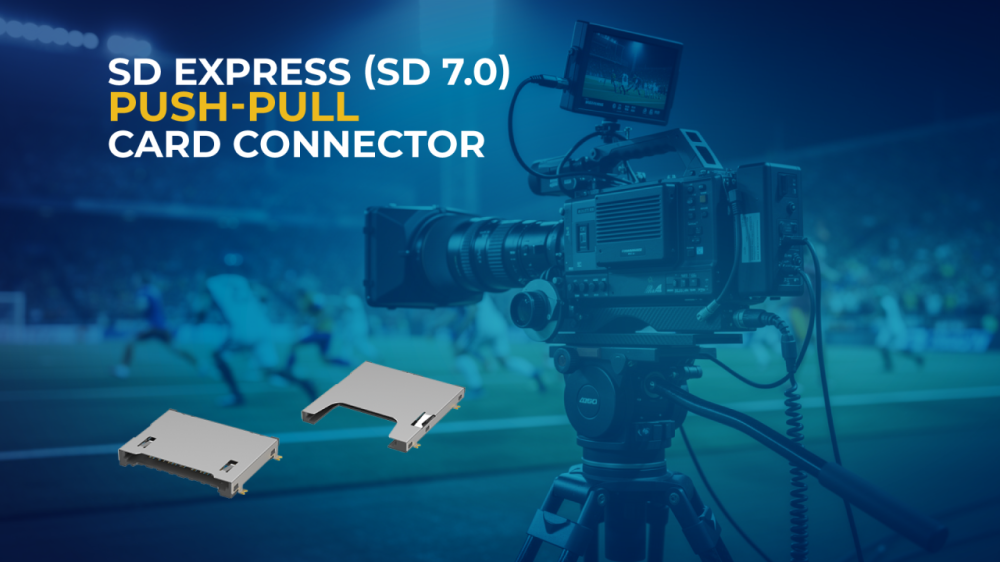
Friends who are industrial cameras or edge AI equipment should have had such experience: the equipment runs fine and the image acquisition is smooth, but when the data is written into the memory card, the speed cannot keep up. Especially when 8K video or RAW format continuous shooting, the memory card often becomes the bottleneck of the whole system.
RecentlyATTENDLaunched aSD 7.0 Express memory card socket, it is running to this pain point. It integrates PCIe Gen3 x1 and NVMe interfaces in the overall dimensions of a standard SD card, which can theoretically push the reading and writing speed985 MB/s。
In the past, most of the SD cards used by everyone were UHS-I interfaces, and the highest theoretical speed was 104 MB/s. This speed is basically enough for ordinary cameras or tachographs. But now industrial cameras are always 4K and 8K resolutions. Edge AI equipment needs to record a large amount of raw data in real time. Unmanned aerial vehicles need to record video and process sensor data at the same time. 104 MB/s bandwidth is obviously not enough.
A friend who did drone inspection complained to me before. They used a 4K camera to hang on the drone for line inspection. It took a long time to fly down dozens of GB of data from SD card to computer. If the video needs to be returned in real time during the flight, the speed of the card cannot keep up, and the picture will be stuck and the frame will be lost.
The emergence of the SD 7.0 Express is to bring the reading and writing speed of the memory card to a new level. What does 985 MB/s mean? Shooting 8K video does not drop frames, continuous shooting RAW photos does not get cached, and it only takes a few seconds to export a 4K material.
In simple terms, the ATTEND socket does two things:
One is to plug the PCIe Gen3 x1 interface into a standard SD card. We are all familiar with PCIe. It is a high-speed interface for graphics cards and SSD in computers. When it is used on an SD card, it is equivalent to repairing a highway for the memory card, and the bandwidth is opened at once.
The second is the introduction of the NVMe protocol. NVMe is a protocol designed specifically for high-speed storage, which is much more efficient than the AHCI protocol used in traditional SD cards. With the cooperation of the two, in order to run out of 985 MB/s results.
Another practical point is that this socket is backwards compatible. The old SD, SDHC and SDXC cards can be inserted and used normally. This is very important for equipment manufacturers, because users may still have a bunch of old cards in their hands, and it is obviously unrealistic to completely abandon the support of old cards.
As a technician, it is not enough to look at the speed alone, but also depends on whether the actual design is good or not. ATTEND this socket has several design details worth saying:
Design of high speed differential contact: In order to run PCIe signals, the traditional SD card contacts cannot be carried. This socket is specially madeHigh-speed differential signal contact structureAnd impedance control is done on the PCB trace. To put it bluntly, it is to ensure that the waveform is not distorted and the data is not lost during high-speed signal transmission.
Pin detection function: This function sounds simple, but it is very important in actual use. It can judge whether the card is completely inserted in place and avoid reading and writing errors caused by poor contact. In particular, industrial equipment often runs in a vibration environment. Loose cards are a common problem. With this detection mechanism, the system can detect and alarm in time.
Compatibility Handling: The UHS-I interface circuit is integrated inside the socket, so when the old card is inserted, the system will automatically switch to the UHS-I mode. The advantage of this design is that the equipment manufacturer only needs to cloth a set of circuits to support both the new and old cards, and the hardware cost and software driver workload are reduced.
The application scenarios of this scheme are basically embedded devices that require high write speed:
8K Video Capture EquipmentWhether it is an 8K industrial camera or a high-end 8K camera, high-speed writing support is required. With a bandwidth of 985 MB/s, the original data running at 8K 30fps is basically enough.
High Speed Industrial Imaging SystemFor example, the high-speed inspection camera on the production line needs to capture dozens of high-definition pictures per second. If it cannot be saved, it is equivalent to white shooting. High-speed memory card is the key to ensure the detection accuracy.
Drones and aerial photography equipment: UAV has limited flight time in the air. If the storage speed cannot keep up, either the image quality will be reduced or the flight time will be shortened. With high-speed storage, high-quality video can be recorded and sensor data can be saved at the same time, and post-analysis is more valuable.
Edge AI deviceSuch devices typically need to record large amounts of raw data locally for model training or real-time inference. For example, a self-driving test car may generate hundreds of GB of data in one test cycle, and the storage speed directly determines the test efficiency.
Multi-channel IoT acquisition system: A device is connected to more than a dozen sensors and generates a large amount of data every second. If the local storage is not effective, the data will be lost. High-speed SD card can be used as a temporary buffer, such as the network is smooth to upload.
For engineers who are working on the above products, choosing the right storage interface is only the first step. How to quickly get samples for verification and how to ensure stable supply during mass production are also the keys to the success of the project.
BonChip ElectronicsAsAuthorized Distributor of ATTEND Connector ProductsI can help a lot here. We not only have this SD 7.0 Express socket ATTEND in stock, but also provide technical support. For example, engineers are not sure about PCIe signal routing. We can assist in the reference design of impedance matching. If there is a shortage of materials during mass production, we can also help you coordinate through a stable supply chain.
Our principle has always been: customers just do a good job in product design, material supply to us. From a few samples in the R & D phase to bulk orders in the ramp-up phase,BonChipall promised to provideThe most convenient delivery and the most competitive price。
From UHS-I to SD 7.0 Express, the evolution of memory card interfaces reflects the changing demand for data processing capabilities across industrial equipment. It used to be good enough, but now the sooner the better. The emergence of ATTEND socket allows equipment manufacturers to increase storage performance by nearly ten times without changing the size.
If you're designing the next generation of industrial cameras, AI edge devices, or drones, take a look at this new interface. After all, in the matter of high-speed data recording, the more bandwidth, the more calm.