Search for
All you need
What do you need to look?
In recent years, cameras have not only appeared on mobile phones and home surveillance. Walking on the road, cameras can be seen everywhere in the surround view system of commercial vehicles, the safety monitoring of buses, the operation monitoring of agricultural machinery, and the safety inspection on the construction site. However, when the camera moves from indoors to outdoors, from inside the cabin to the outside rearview mirror or roof of the car, the environment it faces is completely different.
Engineers who have worked as on-board camera systems all know that the products are well measured in the laboratory, and the problem comes out as soon as they get on the bus and run for a few months-the picture gets dark from time to time, or it doesn't light up at all. This is often a problem with the connector. For outdoor camera systems,The reliability of the connector is sometimes more important than the resolution of the camera.。
Today's multi-camera systems have been widely deployed in various outdoor scenarios, such:
Commercial Trucks and Fleet Vehicles
Monitoring system for buses and coaches
Agricultural machinery (tractors, harvesters, etc.)
Construction machinery (excavators, cranes, etc.)
Intelligent transportation infrastructure (roadside monitoring, electronic toll stations)
Outdoor machine vision platforms (e. g., outdoor trucks for automated storage)
The installation positions of these cameras are also varied: under the rearview mirror, on the bumper, on the roof, at the rear of the trailer, on the mechanical arm of the equipment, outside the outdoor cabinet... In short, it is installed wherever it needs to be seen. The location of the camera basically determines what kind of environment it has to endure.
Water and dust are the first hurdle
The outdoor camera should face the rain, the high-pressure water gun when washing the car, the muddy water splashing on the road, the dust on the construction site, the salt spray in the air... If the protection level of the connector is not enough, the water vapor and dust seep along the interface, the light signal attenuation, the heavy direct short circuit. The common FAKRA connector itself does not have a waterproof function, but if equipped with a sealed design adapter, it can be doneIP67 or even IP69K level. IP67 means that it is completely dust-proof and can soak in 1 meter deep water for 30 minutes without water. IP69K is even more ruthless and can withstand high-pressure hot water flushing-which is very practical for commercial vehicles that often need to wash cars.
Vibration and mechanical stress are long-term torture
When commercial vehicles and construction machinery work, vibration is almost ubiquitous. The vibration of the engine, the bumps of the road, the swing of the mechanical arm... These vibrations will wear the contact terminals of the connector a little bit, resulting in greater contact resistance and reduced signal quality. After a long time, there may even be intermittent disconnection.
Before, I helped a customer who was working on the bus fleet monitoring system to investigate the problem. They found that a certain camera would lose one or two frames every few days, and they couldn't find the reason. Finally, the connector was disassembled and found that there were obvious signs of wear on the surface of the terminal, which was caused by the daily bumps of the bus. Changed itATTENDAfter the FAKRA connector with lock buckle structure, it also ran for a month without any problems.
Aging problems caused by temperature changes
Outdoor cameras have to endure summer exposure and winter cold, and the operating temperature range is usually-40°C to 105°C. This alternation of cold and heat not only tests the endurance of electronic components, but also a great test for the plastic shell and sealing ring of the connector. Temperature changes will lead to thermal expansion and contraction of the material, the long-term sealing ring may lose elasticity, waterproof performance decline; plastic shell may become brittle, the impact is easy to crack.
Maintenance pressure for long-term service
Many industrial equipment and transportation vehicles have a design life of more than 10 years, and during this period, maintenance opportunities are very limited. You can't expect to disassemble and check the condition of the connector every three months. Therefore, the long-term reliability of the connector is directly related to the availability and maintenance cost of the entire system. Choose a reliable connector, the early cost may be slightly higher, but the later maintenance costs saved are far more than this difference.
At present, the mainstream car cameras use FAKRA and Mini FAKRA interfaces, with frequencies supporting up to 6GHz and Mini FAKRA even up to 20GHz, which is enough to run 4K or even 8K video streams. But in an outdoor environment, engineers need to consider not only signal integrity and bandwidth, but also these issues:
Sealed through design: The signal must pass through a sealed "channel" in the middle to pass through the external cable from the inside of the device, and water cannot be allowed to flow in along the cable.
IP protection level selection: Depending on the installation position (roof, bumper, chassis), the requirements for waterproof and dustproof are different. The front bumper is prone to splashing mud and water, and the roof is exposed to the sun and rain for a long time.
Cable fixing method: In vibration environment, if the cable is not firmly fixed, it will swing back and forth and pull the connector terminal, resulting in poor contact. Therefore, the cable of the outdoor camera system generally needs to be fixed on the body with a special buckle.
Long-term maintainability: If a camera is broken and needs to be replaced, can the connector be easily plugged and unplugged? If the sealant is killed, the entire cable must be replaced once it is removed, and the maintenance cost is very high.
For the connection needs of outdoor cameras and vision systems, ATTEND provides several sets of sealed RF connection solutions, mainly including:
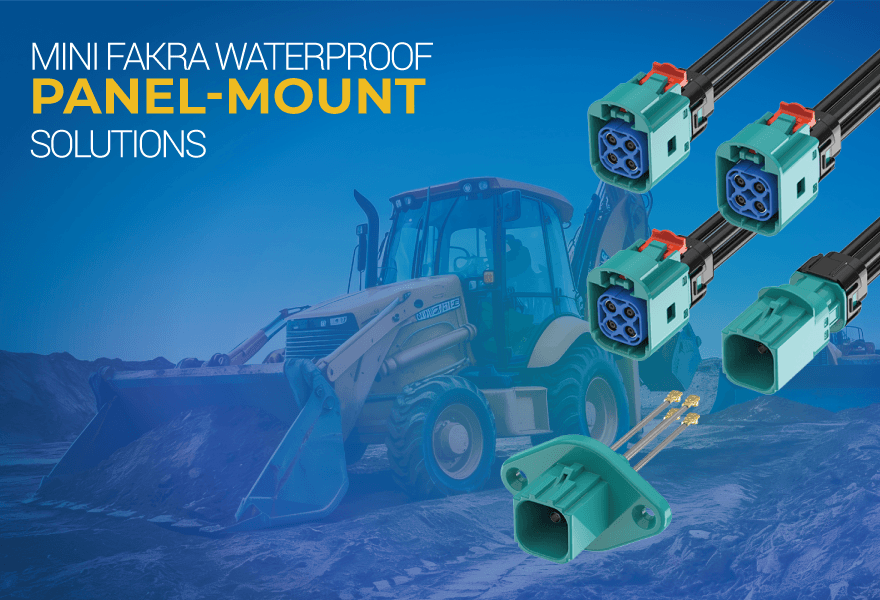
Mini FAKRA Waterproof Panel Mount Connector
FAKRA and Mini FAKRA Cable Assembly
Sealed through design with IP67/IP69K rating
High vibration-resistant coaxial interconnection scheme
One of the more distinctive is the Mini.FAKRA Series. Its volume is much smaller than the traditional FAKRA, and more camera signals can be arranged on the PCB of the same area, which is suitable for multi-camera systems. The sealed version is specially optimized for outdoor applications. A sealing ring is added between the connector shell and the panel, and glue is poured at the outlet of the tail end, which can effectively prevent water vapor from penetrating into the equipment along the cable.
In addition, ATTEND's products have passedUSCAR-2andUSCAR-17Standard testing, which is the automotive industry's stringent requirements for connector vibration, shock and temperature cycling. Simply put, the connector can still work stably even if it is installed in the car and runs for more than 100,000 kilometers.
For many design teams, selecting a connector is just the beginning. The real challenge lies in how to quickly obtain samples for testing and how to ensure a stable supply during mass production.
BonChip ElectronicsAsAuthorized Distributor of ATTEND Connector ProductsWe maintain a long-term in-stock inventory of automotive connectors, including FAKRA, Mini FAKRA, and HSD. Whether you need a few sample units for validation during the R&D phase or bulk supply in mass production, we can respond swiftly.
Sample supportCommon specifications are shipped within 48 hours, allowing you to quickly set up your test environment.
Technical IntegrationIf you’re unsure about the PCB footprint design for connectors or have questions about selecting the appropriate IP rating, our engineers can assist by providing expert recommendations.
Stable supplyLeveraging ATTEND’s global supply chain and BonChip’s local inventory, we ensure an uninterrupted supply of materials during the mass-production phase.
Flexible deliverySmall batches are no problem, and we can also guarantee on-time delivery for large volumes.
Our principle is simple: let customers focus on product design and system integration, and leave material procurement to BonChip. From sample to mass production, and from component selection to delivery, we provide end-to-end support throughout the entire process.
The deployment of camera systems in outdoor environments is not a new requirement, but as the number and resolution of cameras continue to increase, this need is becoming increasingly common and urgent. Meanwhile, connectors, as critical nodes in signal transmission, are often undervalued—only when problems arise do people regret it.
For engineers designing outdoor camera systems, it is crucial to address early in the project phase…Environmental protection, vibration-resistant design, sealing solutionsIncluding it in the selection process saves far more time and effort than patching it up later. Choosing the right connectors and the right suppliers marks the starting point of this process.